
Crysp Showcases Global Leadership in Digital Twin Innovation at Washington DC Summit
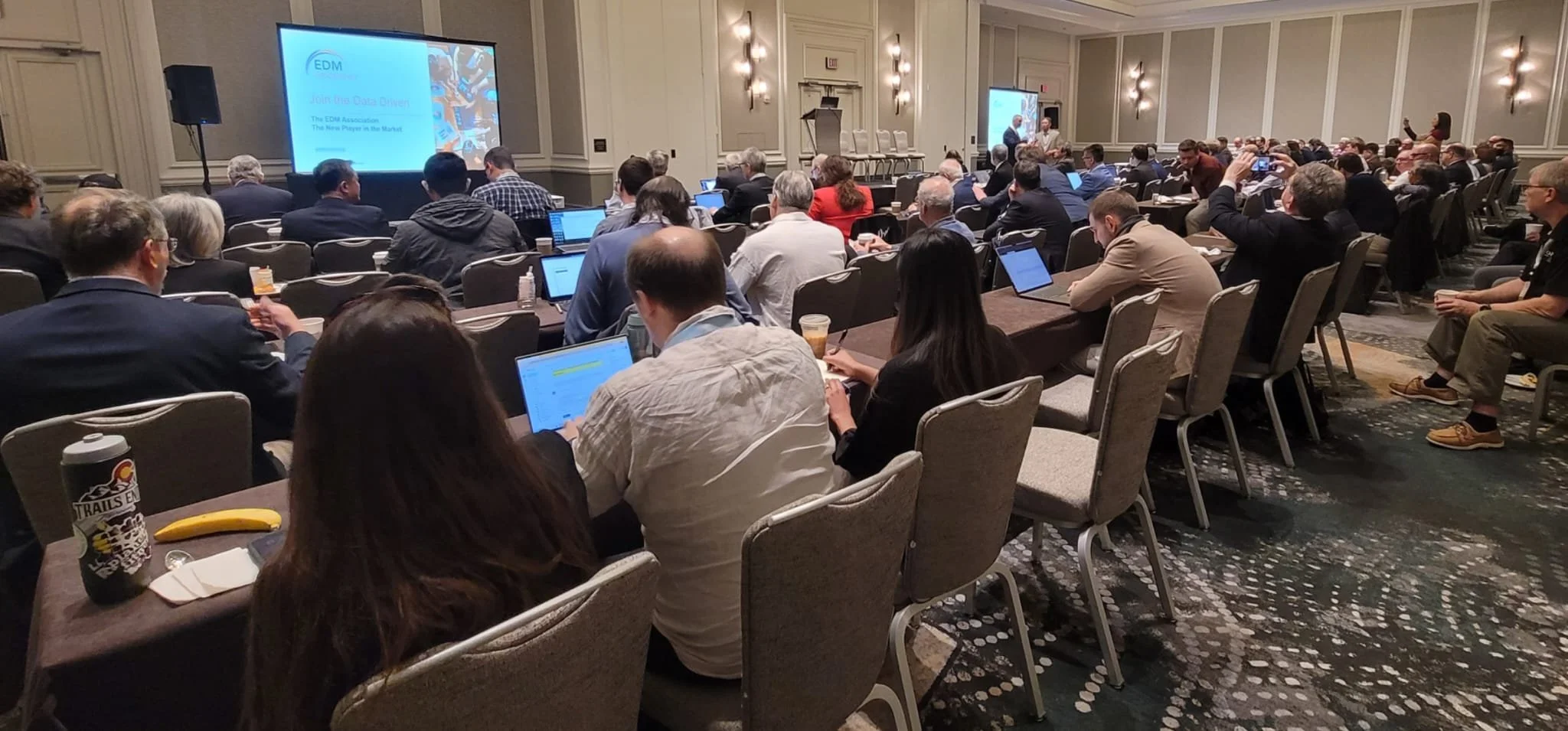
One of the breakout sessions from the conference
Crysp Showcases Global Leadership in Digital Twin Innovation at Washington DC Summit
Washington DC — At a landmark gathering of global technology leaders, Crysp played a central role in shaping the future of digital engineering and assured digital twins. The event brought together leading organisations including the Digital Twin Consortium (DTC), AREA, OMG and EDMA, alongside hundreds of senior figures from across the international technology ecosystem.
At the heart of Crysp’s contribution was the unveiling of the Crysp/Nexus blueprint for assured digital twins—a pragmatic and structured approach designed to bring clarity, trust and scalability to digital twin deployment across industries.
A key milestone during the summit was the relaunch of the Digital Twin Capabilities, Technology and Digital Engineering Working Group, chaired by Crysp’s leadership alongside Professor Antonio Kontsos of Rowan University and Marlon Rodgers of Lockheed Martin. This revitalised group brings renewed focus to advancing standards, collaboration and real-world application of digital twin technologies.
Working closely with co-chairs and industry peers, the group aligned on adopting the Crysp approach, which clearly delineates three critical layers:
Data and the digital thread
Data structures, ontologies and models
Artificial Intelligence
Importantly, this framework introduces a further distinction within AI itself—separating reasoning-level intelligence from agentic automation. This layered perspective was widely welcomed as a necessary step towards reducing complexity and enabling more robust, interoperable systems.
One of the most thought-provoking discussions of the event, led in collaboration with Philippe Delanoye of Dassault Systèmes, became the defining theme of the summit’s final day. The discussion centred on a nuanced but increasingly important idea:
digital twins do not inherently require AI—but industrial and physical AI, in most cases, require digital twins.
This perspective resonated strongly with attendees, reframing how organisations think about the relationship between data, simulation and intelligent systems.
Crysp also used the occasion to relaunch its strategic partnership with Rowan University’s Digital Engineering Hub, reinforcing a shared commitment to research, education and the practical advancement of digital engineering capabilities.
Beyond the US engagement, Crysp continues to drive impact closer to home. Recent focus groups led with the NHS explored the development of the Yorkshire Synthetic Kidney Digital Twin Programme - a pioneering initiative aimed at transforming patient outcomes through advanced modelling and simulation.
Reflecting on the week, Dr David Mckee described the experience as both energising and deeply collaborative:
“This wasn’t just another industry event—it was a moment of alignment. We are seeing a shift from hype to structure, from experimentation to engineering discipline. The opportunity now is to build digital twins that are not only powerful, but assured, trusted and truly useful.”
With growing global momentum, Crysp remains at the forefront of defining how digital twins, data and AI converge to shape the next generation of intelligent systems.